This is part 1 in a series that explains how the Australian political system works.
Australian government explainer, Part 1
31 May 2026·12 min
Note
I’ve been fairly obsessed with Australian politics in the last few months, between graduating and starting my PhD. I had nothing to do, so I was almost religiously reading the news to pass the time (by disabling YouTube and Instagram on my phone, I’ve swapped one form of doomscrolling with another). From there, I felt as though I had a solid understanding of how our political system works - the political parties, preferential voting, as well as lots of Canberra jargon.
Sometimes my friends would talk about things that affect their lives, as we all start to enter “the real world” - paying off university debt, renting/buying a place, investing. For me, those things tied pretty clearly with the news I was reading - this party is for this, so their policies would be better suited to your situation. Some bill is getting delayed that relates to what you’re saying, but it’s being held up by this process. This organisation says they support the things you want to support, but their actions tell a different story. For a lot of people, they vaguely know about the big political parties in Australia, and the fact we vote every few years, but they simply never had the time to look into how it all works.
This guide, therefore, is for my friends, but hopefully it will be useful for anyone trying to understand how our political system works.
To start with, let’s go through the big organisations and places where laws are made and things are decided. Australia is a federal, constitutional monarchy that is also a representative democracy - these terms all tell us something about the way Australia is run.
Federation
The current nation of Australia was founded on January 1, 1901, after the six British colonies occupying what is now Australia (New South Wales, Victoria, Queensland, Tasmania, South Australia, Western Australia) decided to work together on issues affecting all of them and, therefore, create a country encompassing all of them. The way they did so was to create a national body that would have powers on matters that had to do with the entire country, while still keeping their existing systems of government - this is known as federation.
As of 2026, there are six states and two territories which are represented in the federal government - the original six colonies, as well as the Northern Territory (which split from South Australia in 1911) and the Australian Capital Territory (which houses Canberra, the country’s capital, carved out from New South Wales in 1911). Originally, both territories were directly run by the federal government, but they were eventually given powers similar to that of states - NT in 1978, ACT in 1988.
Because the states never gave up their own governments and only came together because they all decided they wanted to (in the territories’ cases, they gained governments), power and decision-making is divided between the Australian government and the state/territory governments, as well as local governments within each state/territory, run by councils.
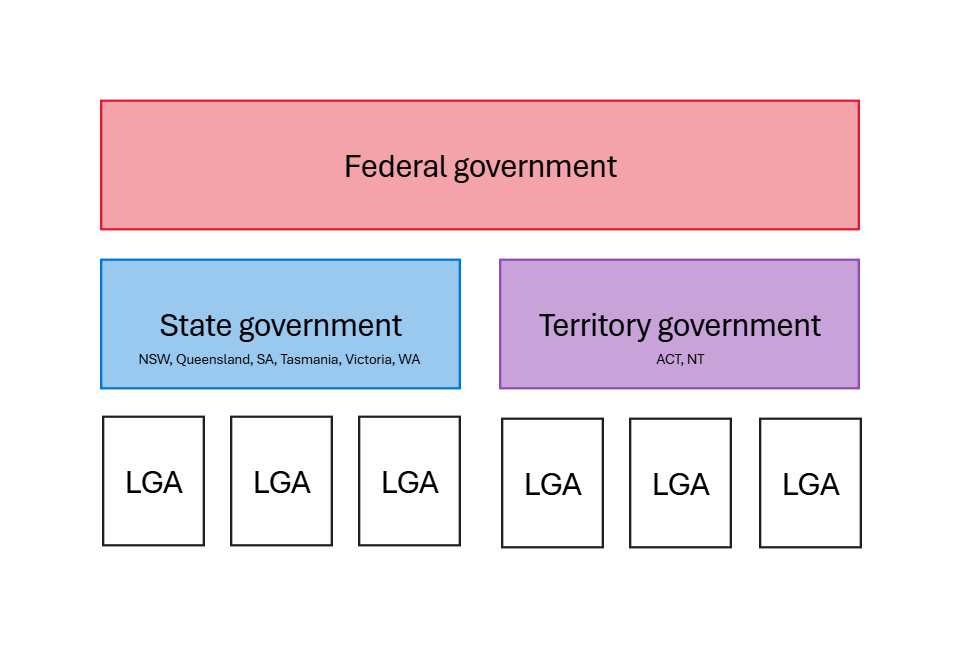
The federal government is generally responsible for:
- Immigration
- Defense
- Relations with other countries (defense agreements, trade deals)
- National programs (Medicare, the NDIS)
- Infrastructure crossing state boundaries (highways, telecommunications, post)
State and territory governments are generally responsible for:
- Major roads (e.g. state highways)
- Hospitals
- Public transport (trains, buses, trams)
- Schools
- Policing
Local governments are generally responsible for:
- Local roads
- Parks, sports fields
- Rubbish collection
There are some areas of overlap between the different levels of government - for example, the federal and state/territory governments are jointly responsible for health and education, and all three levels of government raise money through different types of taxes (e.g. federal income tax, state payroll tax, council rates).
Because of this sometimes-shared responsibility, which is complicated by the fact that the three layers of government could be run by people from different political parties (and thus, have different goals), there have been ways developed over the years to resolve differences. The Constitution of Australia states that if federal and state/territory laws conflict with one another, federal law is followed. The National Cabinet, a group made up of the prime minister and all premiers (leaders of states) and chief ministers (leaders of territories), meets when matters of joint responsibility need to be organised and decided quickly, such as during the COVID-19 pandemic (health), the Port Arthur and Bondi massacres (gun laws), or the Iran fuel crisis (fuel supplies and distribution).
Constitutional monarchy
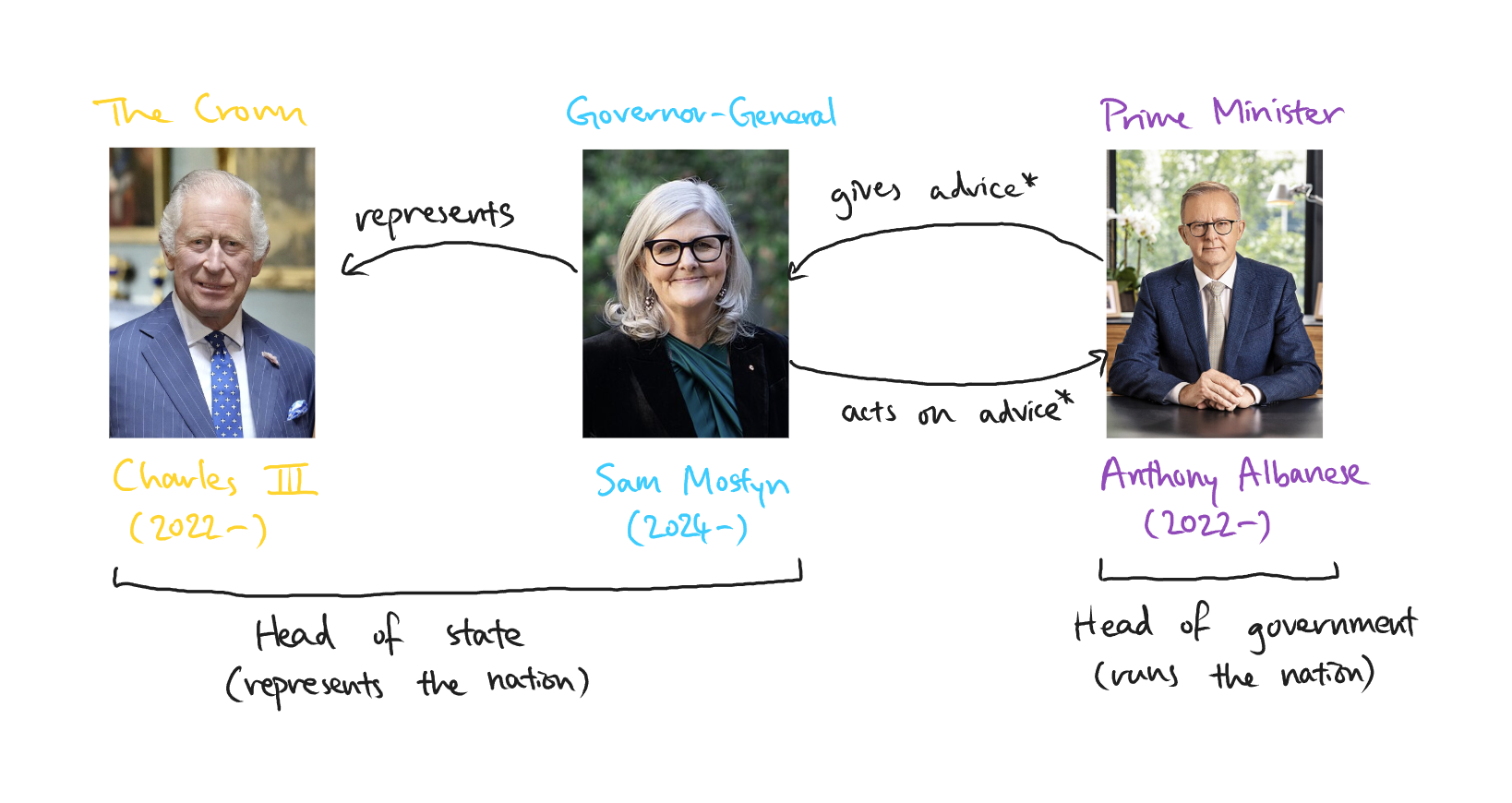
Because the colonies that now form Australia used to be a part of the British Empire, Australia is still technically under the British monarchy, where the monarch (as of April 2026, Charles III) is technically the ruler of Australia. However, practically speaking, power rests in the hands of the elected governments on all three levels (federal, state and local), whose structure and governance is outlined in the Constitution. Thus, Australia is a constitutional monarchy.
The monarch is therefore a figurehead, and doesn’t exercise their theoretical power due to centuries of laws and convention - informal, agreed-upon rules that are not legally defined, but would cause mass controversy if broken. For example, one of their powers is the ability to decide whether new laws have power or not - all bills (proposed laws) in the UK Parliament have to go through the monarch in what is known as royal assent, where the monarch “allows” it to become an act (enforceable law). However, by convention, the monarch essentially acts as a “rubber stamp” and approves everything that has already been decided on by the Parliament, since if they didn’t automatically pass a law, then it means that the Parliament is powerless against the monarch, resulting in institutional and societal breakdowns.
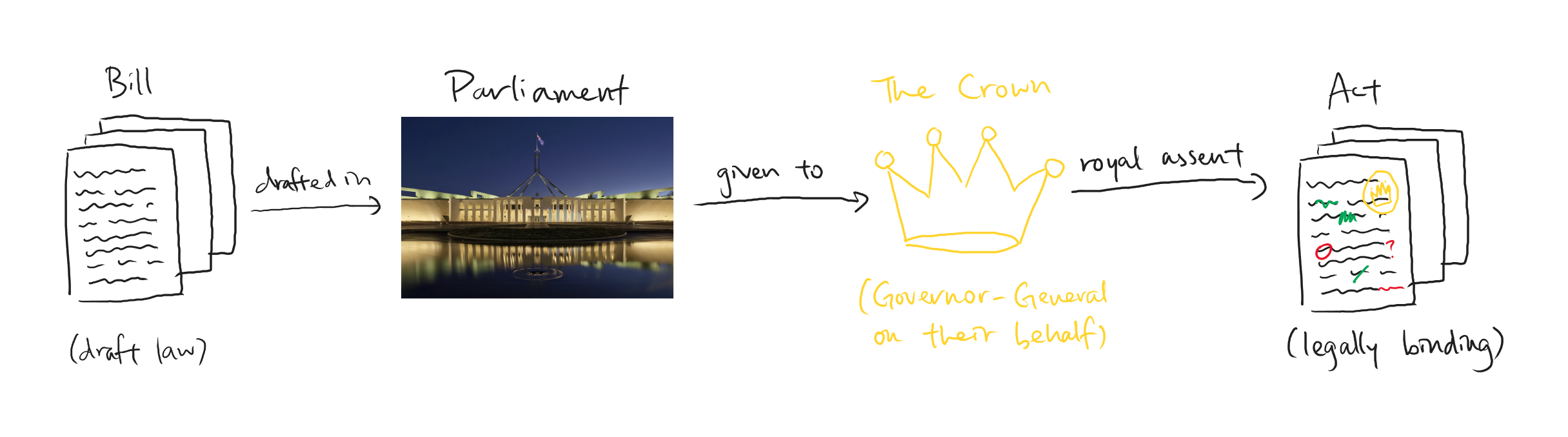
In many Commonwealth countries (countries that were formerly part of the British Empire), the British monarch does not directly perform ceremonial duties like royal assent. Instead, they assign someone to do those duties on their behalf for each country - in Australia, this person would be the governor-general. They are appointed by the Prime Minister, and are usually Australians who have significantly contributed to the nation (Sam Mostyn, the current governor-general as of April 2026, was a Commissioner and later President of the AFL, and an advocate for climate change and gender equality). Under this model, the governor-general is the head of state, someone who is the “public persona” of the country, while the prime minister is the head of government, and does the day-to-day running of the country itself.
The governor-general has the duty of approving bills before they become law, as well as the powers to dissolve parliament - “clearing out” all federal politicians in the Australian Parliament, thereby triggering a new election, and to dismiss the government - formally saying the current government is not allowed to lead the country, also most likely triggering a new election.
It is similarly under convention that the governor-general doesn’t exercise these “reserve powers” by themselves, to ensure that the politicians elected by the people have the final say. Parliament is dissolved, for example, only “on the advice of the prime minister”, i.e. when the prime minister tells the governor-general to do so.
This convention has only been broken once since Federation - in 1975, the Senate, controlled by the Liberal Party under Malcolm Fraser, refused to pass the budget proposed by the Labor Party under Gough Whitlam. As the deadlock would result in the government not able to give money to various departments that actually run the country, Whitlam went to the governor-general, John Kerr, asking for parliament to be dissolved. Instead, Kerr dismissed Whitlam as Prime Minister and installed Fraser in his place, on the condition that elections were held within six months. The whole saga is known as the 1975 constitutional crisis, and while technically within Kerr’s rights, scholars still debate on whether such powers should have ever been used.
Because of the possibility (and reality) of such controversies, and a desire to create an Australian identity distinct from the British, there have been many proposals to make Australia a republic (a system where political power formally rests with the people, not a monarch). The most high-profile example is the 1999 republic referendum, which ultimately failed. Two prominent organisations related to this debate are the Australian Republican Movement and the Australians for Constitutional Monarchy - former prime minister Malcolm Turnbull was once the chair of the ARM, and another former prime minister Tony Abbott was the first National Director for the ACM.
Representative democracy
The word “democracy” comes from Ancient Greek - “demos” meaning “the people”, and “kratos” meaning “to rule”. Similar to a republic, the power in a democracy rests in the hands of the people, although in modern terminology, “democracy” usually refers to the ability for people in a country to vote and decide on the laws that affect their lives.
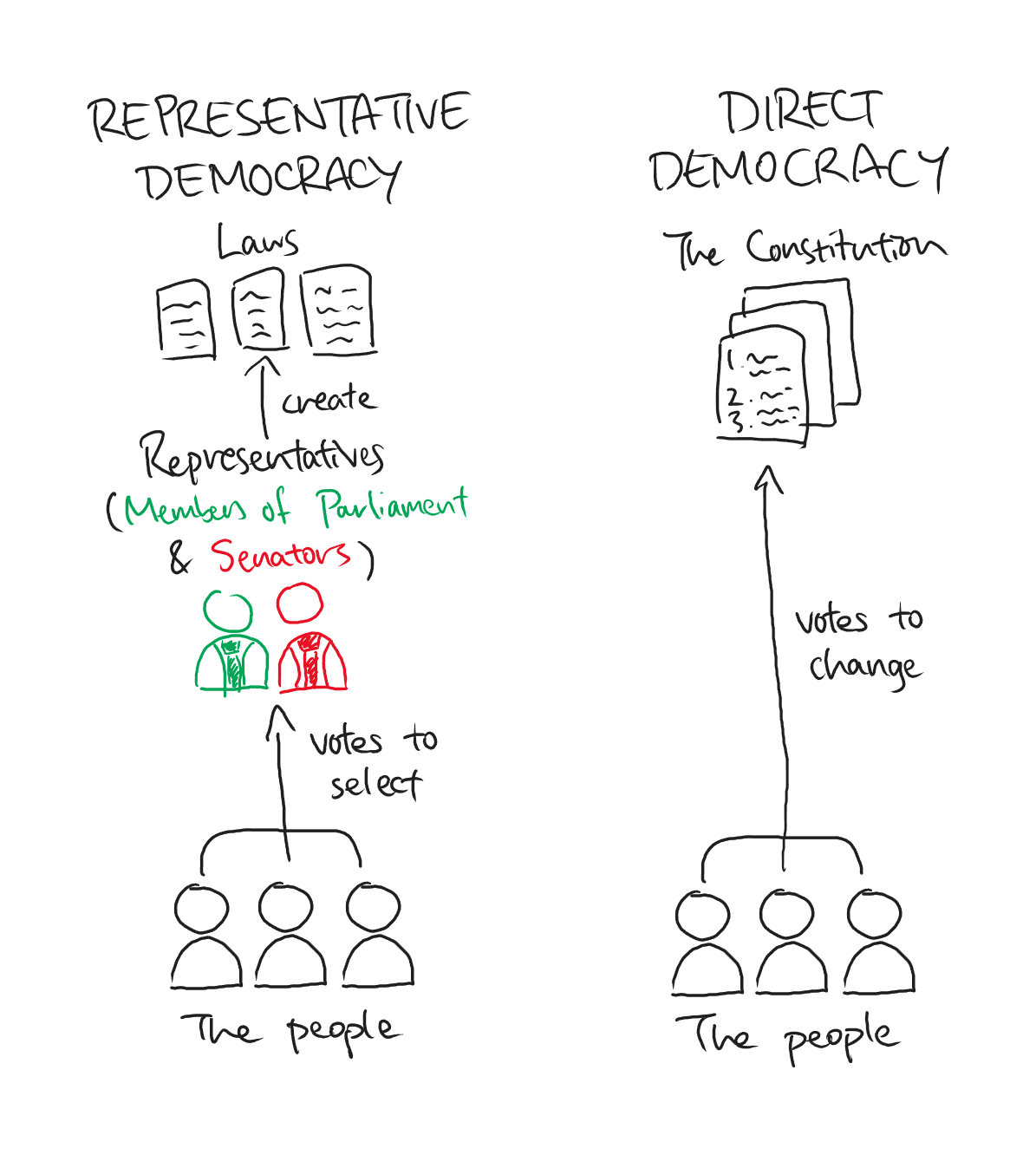
In a direct democracy, ordinary citizens vote on each law. However, not every person is affected by every law (e.g. people without school-age children aren’t directly impacted by changes to the curriculum, people without cars aren’t affected by changes in toll pricing), and the logistics of sending ballot papers to everyone, every time a new law is proposed, is impossible in a country of Australia’s size and population. Thus, in Australia, we have a system where we vote, roughly once every three years, for the people that will draft laws and formally decide on those laws on our behalf. This indirect form of decision-making by the people is known as representative democracy - we vote for people that will represent our interests when decisions are made.
There are still situations where the people directly vote on laws. If a decision by the government affects the Constitution, then a referendum must be held - a nation-wide vote on a specific subject, rather than on who represents our interests. Referendums are legally binding - if one is passed, then the constitution is altered. As of 2026, the most recent referendum is the 2023 Australian Indigenous Voice referendum, that aimed to enshrine an Aboriginal and Torres Strait Islander advisory body into the Constitution.
A plebiscite, a national vote that is not legally binding, is another way that the government can see how Australian people feel about a certain subject. The most recent plebiscite is the Australian Marriage Law Postal Survey in 2017 - a majority of people voted “Yes”, and as a result the ruling Liberal government put forward a bill to legalise same-sex marriage.
Separation of powers
In order to ensure that power is not concentrated in one particular organisation (and therefore, one particular person, if they happen to be in charge of said organisation), nations often divide decision-making abilities into distinct institutions, which are independent from one another. This is known as the separation of powers - in Australia, power is separated into the legislature (Parliament, the people that make laws), executive (the Cabinet, made up of ministers, senior politicians that enact laws), and the judiciary (the courts, the people that judge laws).
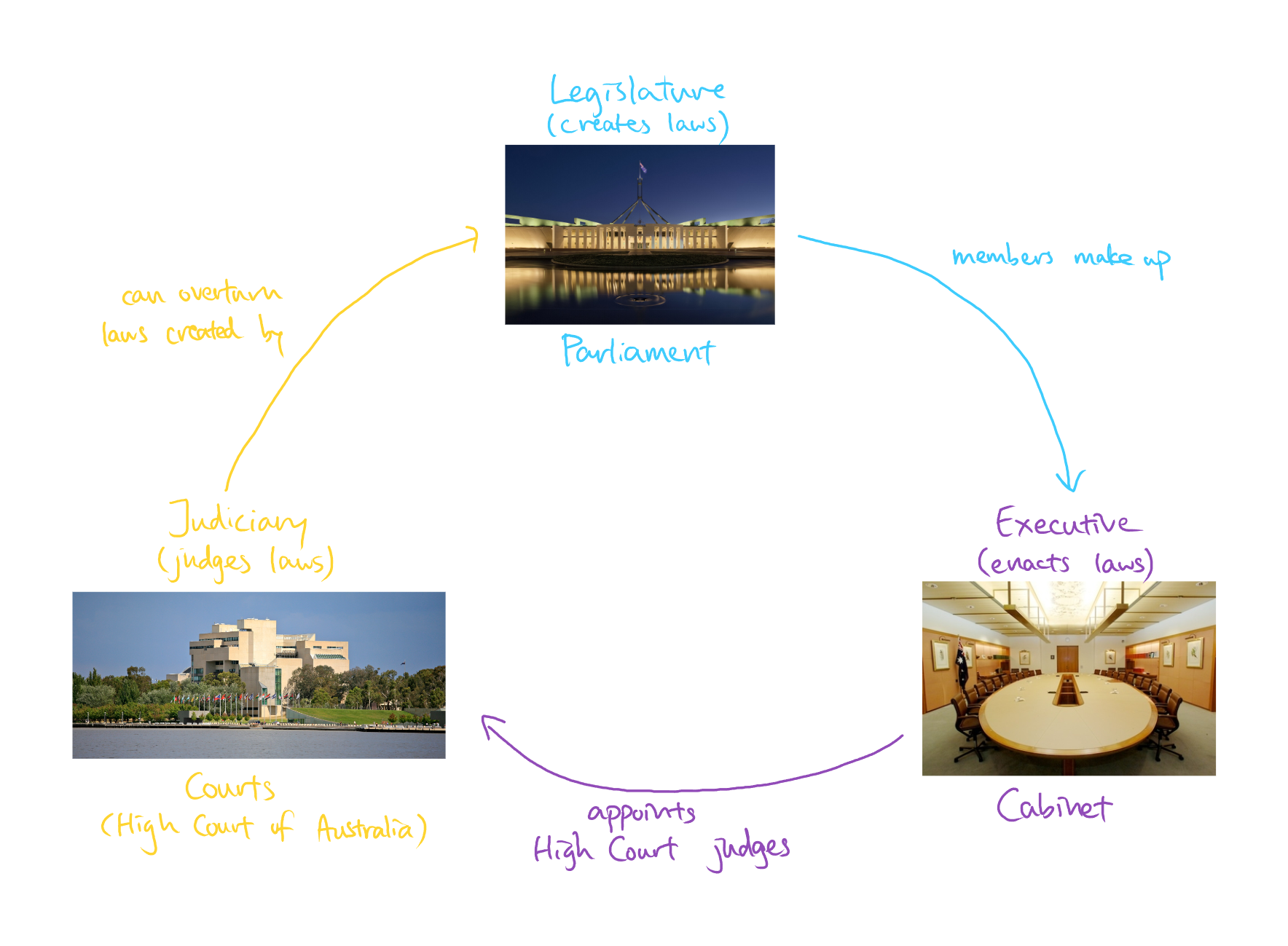
Having distinct “branches” run the country, each with clearly-defined responsibilities, allows each branch to be specialised - judges and lawyers can focus on making judgements on existing laws, and politicians, sometimes with expertise in their field (economists, lawyers, social workers), can focus on directing their respective departments to follow laws. The branches can also prevent each other from acting “out of line”, through a system known as checks and balances - for example, courts can rule certain laws made by Parliament unconstitutional, and anything the Cabinet does must first go through Parliament.
There are also other organisations involved with running the country that are independent, so that their operations aren’t politicised - by convention or law, the executive cannot be involved in their day-to-day activities. Examples include the Reserve Bank of Australia (which creates new currency and controls the cash rate, thereby affecting interest rates), the Australian Electoral Commission (which runs federal elections) and the Fair Work Commission (which determines the national minimum wage and sorts out industry disputes).
Extra links
If you want to learn more, here are some resources that may be helpful:
- Federation and levels of government (link 1, link 2, link 3)
- The Parliament, which includes the Governor-General (link 1, link 2)
- Separation of powers (link)
A lot of the links are from the Parliamentary Education Office, which is responsible for teaching people about how the Australian government works - I didn’t know the specifics about a lot of these concepts going in, and the PEO is a really valuable resource.