Hua Hsu’s Stay True is one of the best books I have read, and is most likely one of the best books I will ever read. Split roughly into three sections, “before”, “during” and “after Ken”, Stay True is a masterpiece on the Asian diasporic experience, the beauty of friendship and the ways we grieve the loss of such friendships. It is colourful, vivid, frenetic - much like the book’s backdrop of California itself - but also tragic, reflective and deeply vulnerable, fitting the LA Times’ quote of “achingly tender” on the front cover.
It’s a story that only Hsu can tell, and it’s a story that only Hsu’s writing style can tell this well. Stay True is a fitting legacy for Ken, despite Hsu’s doubts, and I’m honoured to be able to read it.
Growing up as an Asian immigrant
Before recounting heading into Berkeley as a young adult, Hsu goes over a story that’s been more front-and-centre in Western media recently - growing up Asian in a foreign country. In this first part, as Hsu described his experiences of being Taiwanese-American, and of desperately trying to carve out his own identity, I felt like I was staring at a reflection of myself, far more than Crazy Rich Asians or the A24 darling Everything Everywhere All At Once.
Although my own search for identity was a lot less counter-culture than his was, in Hsu’s vignettes I saw myself slowly swapping pieces of clothing in my wardrobe, adding rings to my outward presentation, trying to separate myself from the computer science zip-up hoodie and jeans and to look like “I put in some effort”. The desire of “defining who I was by what I rejected” in Hsu’s early years I saw reflected, in some ways, in my initial love for translating, to scouring MyAnimeList for hidden gems, to diving deep into Magic: The Gathering.
“Building” your sense of self in a foreign place, and trying to balance it with your home culture, is not all glamourous - recently I’ve noticed how insecure I am about the aspects of me that are “different”, sometimes using it as a flimsy way to be more “cultured” or “in-touch” than other Chinese-Australians.
Hsu’s experience, turns out, was no different - he doesn’t describe his “going against the grain” with any sense of pride, in fact it feels like he’s cringing along the way. And it made me reflect on that insecurity - how my pride in being proficient in both Mandarin and English, a badge of honour in Chinese-Australian society, can so quickly turn into inadequacy as I felt “not Chinese enough” around people from actual, Chinese-Chinese backgrounds. How my desire to be “not like the stereotypes” may, in fact, be a subconscious effort to make me stand out to girls, or to the world in general, like Hsu recalls. It made me think about how desperate I was to be unique, and therefore an irreplaceable part of other people’s lives.
Another reason why this part resonated with me so much is that Hsu refuses to fall into a trap that so many Asian diaspora movies and books make by tongue-in-cheek referencing being good at maths (or “subverting” it by being dyscalculic instead), “white people” mispronouncing their names, or tiger parenting - he refuses to use stereotypes as a crutch. Hsu instead makes “deeper cuts”, with things like the “broken English” in his dad’s fax messages, authentic and raw instead of the borderline-racist attempts made by some other Asian artists to appeal to white audiences. Or where he slowly finds out that his parents aren’t “boring”, with their music tastes carefully preserved in a cross-country vinyl collection - it reminded me of when I talked about movies with my mum, and she rattled off classics from her time before rounding the conversation with “I went to the theatre so often before having you!” These deeper cuts made me feel seen, and hopeful for how works in this third-culture space can evolve.
Meeting Ken
It was really beautiful to see the friendship between Hsu and Ken blossom from when they first met. Hsu’s first impressions were defined purely by differences - Ken was outgoing, handsome and - shudders - mainstream. Most strikingly of all, he was Asian-American, but in a way that showed just how different he was to Hsu. Where Hsu felt he had to constantly put on a mask to seem American, Ken was American, his family has been American for generations, “without a hint of accent”.
But the two added to each others’ lives, their personalities intertwining in so many different ways, being separate yet inseparable. Huascene, as Ken referred to him, still wrote zines, and still carried with him that streak of contrarianism - liking Pearl Jam until the moment they became popular, for example. But he now had someone to discuss the themes of movies with late into the night, to go out “for a smoke” and gain a nicotine addiction with, to drive around the Bay Area with for the shortest list of groceries. In their final days together, they distilled their combined knowledge to hack together a script, Barry Gordy’s IMBROGLIO, to be performed as soon as they got a camcorder.
I think Hsu’s style of writing especially shines when he describes his university days. The way he writes - snappy, almost staccato when describing individual moments clustered around a specific time - makes me think about Polaroid photos. Slightly blurry, tens or hundreds taken at a time, documenting every minute detail as if to recreate a whole. It does help my point that the front cover literally has a camera, and there are full-page photos scattered throughout the book.
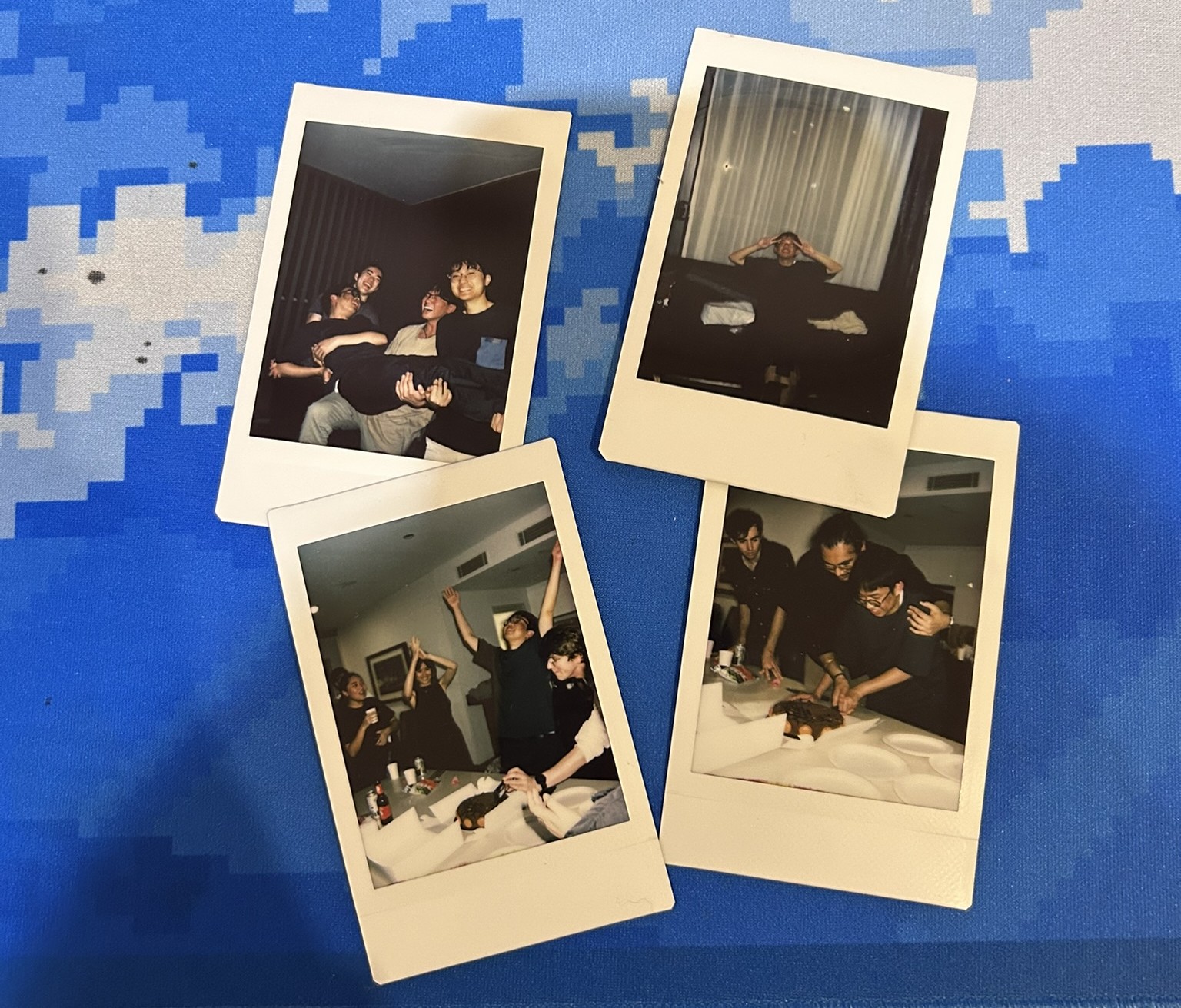
To provide an example:
We were on the roof of our dorm, just after dinner, waiting for the sunset. It was late May - the beginnings of T-shirt and shorts weather, though I opted for a striped, wool sweater I’d recently thrifted. Finding our way to the summit of Ida Sproul Hall was a final curiosity satisfied before moving out.
Snap, a shot of the sunset. Of everyone in T-shirts and possibly baseball caps. Of Hsu’s sweater, perhaps with an orange tinge from the Norcal sun. Of navigating through hallways and a gaggle of people going in all directions, one or two shouting as they discover an emergency exit. Maybe some of them had their doors knocked on and were cajoled into joining the pack.
There are some parts of this section where Hsu alludes to the loss that the book is centred around - when he describes Ken’s aspirations, for instance, or when he talks about the philosopher Marcel Mauss and how his friends’ lives were cut tragically short. But Hsu refuses to sully what were some of the happiest years of his life - the story quickly and suddenly reverts back to his signature slice-of-life staccato, recounting what were perhaps fleeting snapshots of those halcyon years. Then -
All falls down
And in a cruel moment, those routines that Hsu built up with Ken could no longer be revisited. He could no longer listen to “God Only Knows”, choosing instead to embrace the 90s hip-hop that his mentees in Richmond played in their car rides. Hsu’s relationship with Mira, another Taiwanese-American that Ken wanted to introduce Hsu to originally, thinking they’d be a good fit, fizzled as they had nothing to say, nothing they wanted to do. There were no arguments or fundamental disagreements, they just couldn’t continue like this.
Hsu constantly questions his own role in Ken’s untimely death - we see him grapple with survivor’s guilt, if there was anything he could have done. If he had left the party later and not gone to the rave that day. Anything to stop Ken from being kidnapped, dragged three hours out in his own car, and shot through seemingly no rhyme or reason.
An editor for Hardboiled, an Asian-American paper that Hsu and Mira edited for, wanted to look into the murder of a Japanese-American student over the summer, to see if it “constituted a hate crime”. Hsu couldn’t find the words to correct her. If it really was a racist act, it would be a lightning rod for action, something to rage against. But there is a pit where an easy answer normally would be - the simple truth is that “it’s fucked up the way it is sometimes”.
Hsu wants to preserve, so badly, his memories of Ken. In a way, he wants to immortalise his friend, and make sure that he’s never forgotten. So he writes and writes and writes, both as a diary and a spiritual conversation. But is the person he’s writing to Ken anymore?
Memory is a fickle thing, and Hsu notices that with laser precision. After writing for so long, Hsu felt himself struggling with capturing the way Ken laughed into words - somewhat ironic now, given his book won a Pulitzer. Was it like this, or something a little different? Years later, Gwen, a friend of Hsu’s and Ken’s, asked him if he and Kenny were really that close. They were, because he kept telling himself and others that it was so, and wrote about it all the time, but… were they actually? This close friendship that, by necessity, no one else knew the intricacies about - was it still accurate in Hsu’s mind, or has it become legend? Did he deserve to wade in sorrow all this time, to stay still when everyone else has seemingly moved on, when he’s able to summon fewer and fewer details of Ken?
How do we honour a friend’s legacy?
There are a lot of references to philosophy in Stay True, but I want to highlight a snippet on Marcel Mauss, which at least answers the question of “how do we honour a friend’s legacy” that Hsu grappled with so much throughout the book.
As Hsu describes it, Mauss’s core idea of gift-giving was inspired, at least indirectly, by contemporaries whose lives ended prematurely - from the Great War, from sickness. Despite this, it is only through interacting with those friends and colleagues that Mauss could formulate his central idea - that giving gifts goes deeper than just expecting something in return. Mauss thus in effect goes against utilitarianism, the dominant European school of thought. And in a way, he honours his fellow philosophers through his published ideas, creating an untold legacy in the process.
Our friends shape us in ways that are visible, and ways that aren’t immediately obvious. Ken certainly did that for Hsu, and perhaps no matter what Hsu writes, he is honouring Ken, even if he remembers the specifics of their interactions less and less, or if he grieves in a different way.
Closing thoughts
Stay True is about a lot of things that seem disparate at first glance, but are deeply intertwined with one another. The book drew me in by speaking to my own experiences, almost holding a mirror in my face. But after that it describes, in excruciating detail, how Hsu and Ken built their friendship up brick by brick, while having something even more to say about the Asian third-culture experience (or the fact it’s not a monolith).
Even after Ken’s passing, Hsu refuses to let his writing be purely sorrowful - there are sections where he recounts joyful memories of their past, or of him taking steps forward and interacting with the world around him. Like interacting with the Richmond kids, for instance, or connecting with inmates at San Quentin. Or of venturing far beyond his bubble of Berkeley, landing hundreds of miles (kilometres for everyone else) away in Boston, and unpacking everything with his university-provided therapist.
Hsu ultimately fulfilled his promise with said therapist, to “write about all this one day”, and honoured Ken with his words. He summarises his intentions with Stay True well at the very end of the book, after eschewing the established choppy rhythm with what is basically a conversation to Ken (which broke me):
The true account would necessarily be joyful, rather than morose, and surrendering to joy wouldn’t mean I was abandoning you.
And a true account is exactly what he wrote.